
DUI Transfer Support | Supplemental Court Classes & Online Education Options
DUI Transfer Support
If your court, attorney, or probation contact said you need “additional classes” (but didn’t explain what that means), this page helps you choose a safe next step without guessing. You’ll see common scenarios, what to verify, and where to go for self-paced education options when online learning is authorized.
Best for
“I need more classes” situations
Goal
Finish requirements with clarity
Output
Documentation after completion
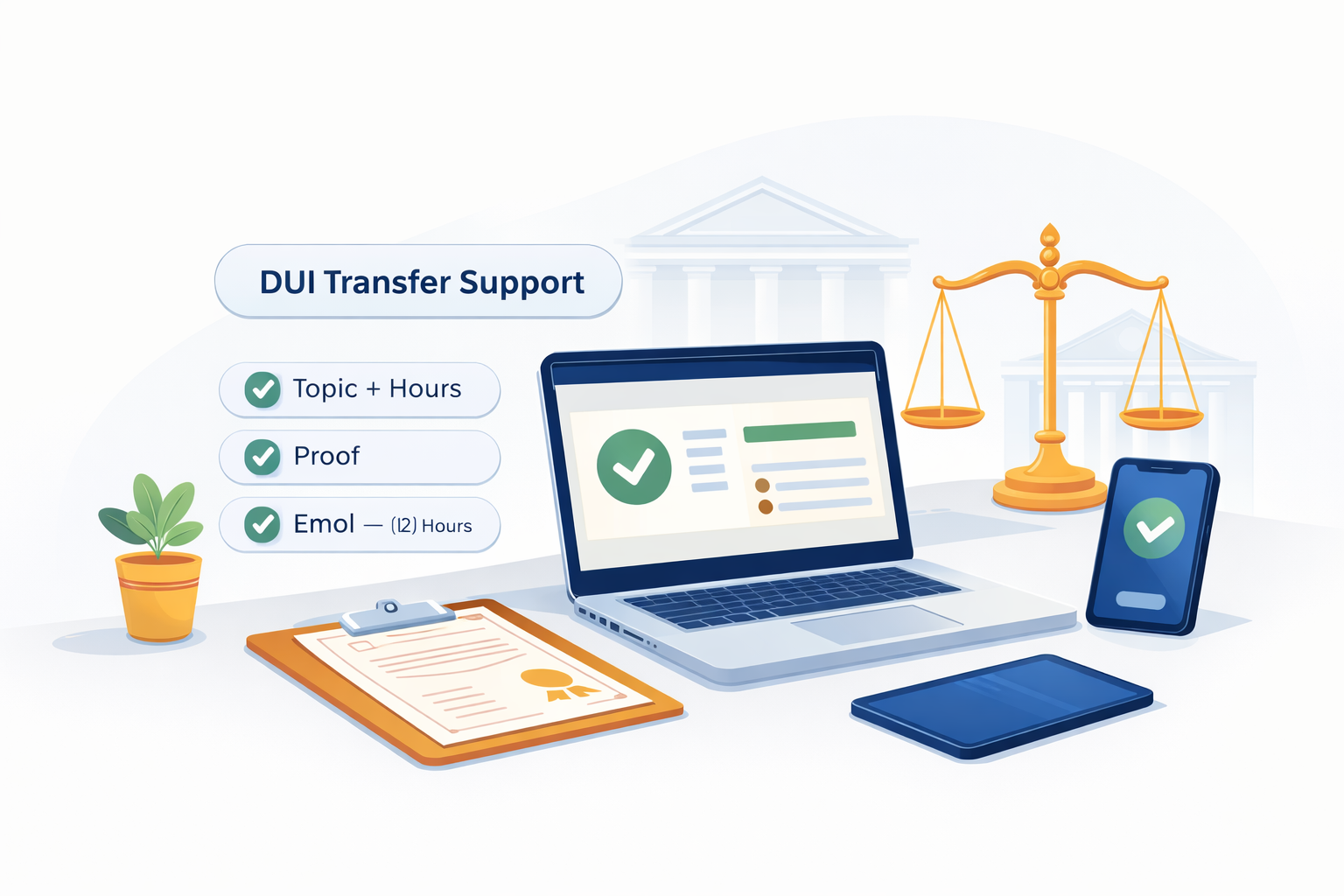
We use “court-accepted” language intentionally: different jurisdictions have different rules and reviewer preferences. If you are unsure what to choose, start with the helper page or browse the course catalog and match your assignment by topic and hours.
Supplemental Court Classes
People often assume a single requirement means a single class. In real life, court instructions are frequently written in plain language that leaves room for interpretation—especially when you live in one state but your case is managed in another. This is where “transfer” and “supplemental” education gets confusing: you may have already completed a program, but your reviewer is asking for an additional topic, additional hours, or a specific type of education that feels unrelated at first.
The goal here is not to overwhelm you with options. The goal is to help you answer three practical questions quickly: (1) What topic are they asking for? (2) How many hours do they expect? and (3) What documentation do you need to submit after completion? Once you know those three items, choosing the right path becomes simple.
“Complete additional education,” “take a class,” “complete a program,” “attend a course,” “provide proof,” or “submit documentation.” If the instruction doesn’t name the topic (anger, theft, substance awareness, etc.), you’ll want to verify the topic before you enroll.
Online acceptance often depends on your local reviewer’s policy, your case type, and whether the education is viewed as instructional (classes) versus clinical (treatment). If your instruction says “therapy” or “counseling,” ask for clarification—education and therapy are not the same thing.
Additional Court Education
If your requirement is vague, your fastest path is to verify the details in a way that doesn’t waste time. Use the steps below to identify what you need and move forward confidently.
Additional Court Education — confirm topic
Look for keywords like anger, theft, substance, decision-making, victim impact, or “behavioral” education. If there’s no keyword, ask your reviewer: “What topic should the class cover?”
Additional Court Education — confirm hours
Your paperwork may list a number of hours (for example, 8, 12, or 24). If it doesn’t, ask: “Do you require a specific hour length?”
Additional Court Education — confirm proof
Most reviewers want a certificate and sometimes a completion summary. Confirm what they want you to submit and the deadline for submission.
Once you know topic + hours + proof, the rest is straightforward: choose an education option that matches the assignment, complete it at your pace, and submit your documentation. If you’re still unsure, start with the helper page and use the guided steps.
Probation Education Options
The most common “extra class” requests tend to fall into a few categories. Below are high-frequency topics that reviewers commonly ask for when they want additional accountability education. Use these options if your instruction matches the topic.
Often requested when paperwork references behavior, impulse control, communication issues, or “anger.” Choose a course that focuses on triggers, boundaries, and decision-making—and confirm the hour length.
Often requested for diversion, probation, or court-ordered accountability when theft/shoplifting is involved. Match the assignment by topic and hours, then complete the education and download proof.
Often requested when paperwork references substances, decision-making, risk reduction, or “awareness.” This is education (not therapy) and can be used when your reviewer authorizes online completion.
Often requested when paperwork references driving behavior, traffic safety, or decision-making behind the wheel. Match the hour length to your requirement, complete the course, and download proof.
Often requested when paperwork references cannabis education, substance awareness, or impaired decision-making. Choose the hour length that matches your requirement, then complete and download proof.
If you only have a vague note like “complete a class” or “complete additional education,” don’t guess. Start with the guided helper page and identify the correct course type and hour path before enrolling.
Reminder: acceptance is local. Always confirm what your reviewer expects before purchase.
Supplemental Court Classes
Here are the most common mistakes people make in transfer and supplemental scenarios—and how to avoid them:
Supplemental Court Classes — mistake #1: guessing the topic
If your instruction doesn’t name a topic, do not guess. Ask a one-sentence question: “What topic should the class cover?” One quick clarification can save you from buying the wrong thing.
Supplemental Court Classes — mistake #2: ignoring hour length
Hours matter. If the requirement is 12 hours and you complete 8, some reviewers will reject it even if the topic matches. Match the hours first, then the topic.
Supplemental Court Classes — mistake #3: mixing education and therapy
Education courses are not therapy. If someone says “therapy,” “counseling,” or “treatment,” ask for clarification about whether an education class is acceptable or if a clinical provider is required.
Additional Court Education
Additional Court Education — what if my paperwork is vague?
Additional Court Education — is online education court-accepted?
Additional Court Education — do I get proof after completion?
Additional Court Education — what if they say “therapy”?
Additional Court Education — where do I start right now?
This page is designed for clarity and routing. Always confirm local acceptance and requirement details before purchase.